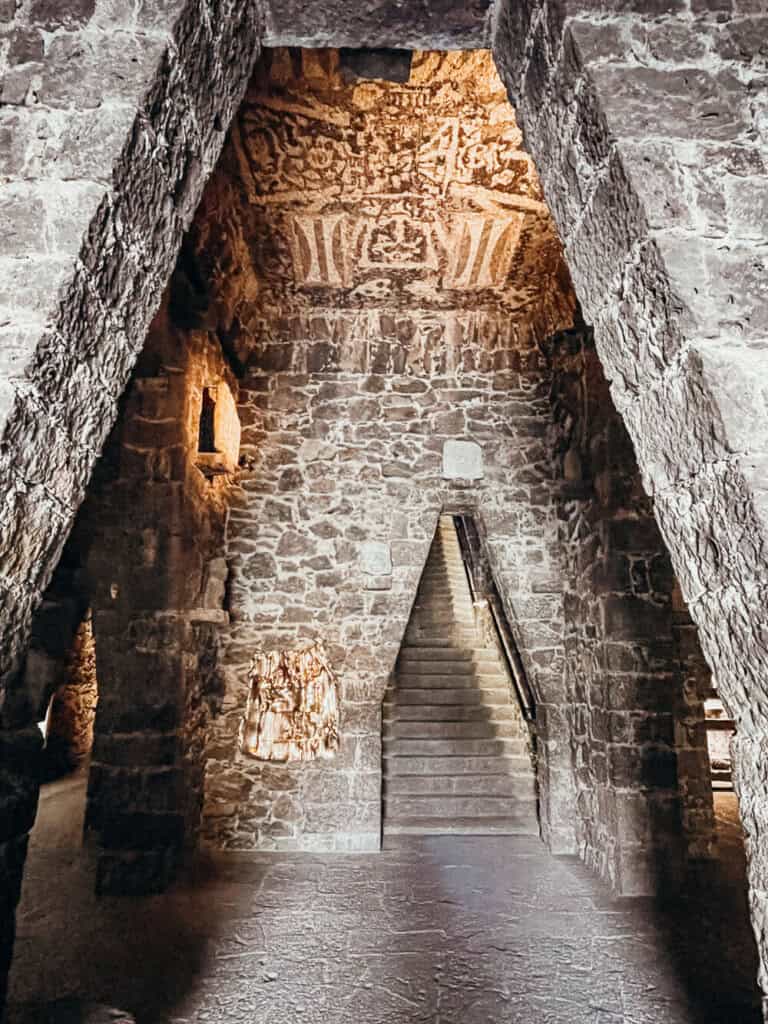
Just beyond the softened streets of Coyoacán, the ground turns dark and uneven, lava rock underfoot, the air quieter. Rising from that black stone is Museo Anahuacalli, imagined by Diego Rivera as a home for Mexico before Spain.
It does not feel like a museum; it feels like a structure that grew from the earth.
The exterior resembles a temple, geometric and heavy, built from volcanic stone taken from the surrounding Pedregal (areas of volcanic rock). The walls are thick, almost fortress-like, yet the building does not intimidate. It anchors. You enter and the temperature drops slightly; sound softens; your pace changes without you deciding to slow down. It reminds me of entering an igloo or the Aurora Art Museum in Fairbanks, Alaska.
Inside, light does not flood the rooms, it slips in carefully. The windows are narrow cuts in stone, rectangles that frame only fragments of sky. A thin beam that lands directly on a clay figure carved centuries ago. The shadows shift as the day moves; morning light is gentle, afternoon light sharpens the edges of everything. You begin to notice time not by a clock but by the angle of brightness against basalt walls.

Rivera filled this space with pre-Hispanic pieces, figures, vessels, deities from cultures that thrived long before colonization. They are not displayed as relics of a lost world; they feel present. The architecture echoes the temple platforms of central Mexico; you ascend rather than wander. Staircases narrow, then open into chambers where stone faces emerge slowly from shadow. You adjust your eyes, you lean closer, you stay longer.
There is also a political current here, subtle but steady. Rivera believed Indigenous history should not be decorative or distant; it should be central. Contemporary installations connect ancient objects to modern questions of land, power, identity. The building itself feels like a statement, solid, deliberate, protective of a story that predates conquest and continues beyond it.
At the top, the terrace opens to the sprawl of southern Mexico City. Concrete, trees, mountains in haze. You stand inside a twentieth century structure honoring civilizations thousands of years old, looking at a city still negotiating who it is.
Anahuacalli does not explain everything. It invites you to stand in shadow, to let the light move across stone, to remember that Mexico did not begin in 1521. It began long before; you can feel it in the walls.
Go when you have time. Let the shadows teach you something.
Grab tickets and dive into architecture, the ancients, and politics with Diego.
Leave a Reply